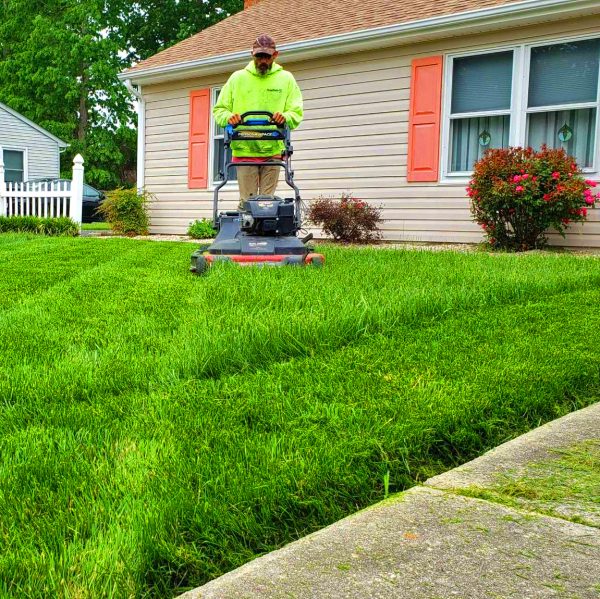
How to stripe a lawn And Other Mowing Tips
How to stripe a lawn is a question homeowners frequently ask. When you are ready to mow your lawn, there are several other aspects to mowing technique that are just as important to both the health of your lawn and its appearance. Mowing height, blade sharpness, and bagging vs. mulching are important considerations as well. Once these basic mowing tips are understood and mastered, a homeowner will be ready to learn how to stripe a lawn.

Proper Mowing Height
The correct height for mowing a lawn varies depending on the type of grass being tended. Generally, warm season grasses like bermuda and zoysia like to be mowed low, under or within just a couple of inches, while cool season grasses like fescue need more height. Turf type tall fescue, the lawn of choice in RVA, gets its name for its desire to stay tall. By tall, we mean keeping it mowed at four to four and a half inches, depending on its sturdiness and the season.
Keeping your fescue tall helps shade its roots and encourages those roots to grow deeper in turn. It also reduces the amount of invasive weeds likely to develop during the summer. However, frequency is just as important as height. It is very stressful to turf to have more than one third of the grass blades taken off at once during a mow. As a result, you do not want to let it grow more than a couple of inches before cutting it again. For example, if you keep your lawn mowed at four inches, do not let its growth exceed six inches before its next cut; taking those two inches off will be one third of its original six inches.
Sharp Mower Blades
A detriment to an attractive lawn is the light haze that can be seen across the top of the turf as a result of dull mower blades. Mower blades should be sharpened at least three times a year to keep them slicing through the grass rather than tearing it. The tear caused by dull blades results in a jagged tip to the grass similar to the hair style of Bart Simpson. This jagged tip dies and turns a pale brown, creating the effect of a light haze across the top of the otherwise green lawn. A good rule of thumb for remembering when to have your mower blades sharpened is to aim for Memorial Day, the Fourth of July, and by the first cut after having your lawn seeded in the fall.

Mulching Grass Clippings
Many homeowners proudly bag their grass clippings without really understanding when and why it is ever appropriate. The mower comes with the bagger, so why not use it? Unfortunately, the process of bagging and removing grass clippings all spring, summer, and fall results in a significant loss of valuable nutrients that would otherwise be supplied back to the soil by those grass clippings. The only time it is really appropriate to bag your grass clippings is when the lawn has grown in excess, such as after seeding. When this happens, bagging needs to be done in order to prevent large clumps of grass from being left on the lawn and smothering out the turf. Otherwise, mulching up the clippings creates a healthy thatch layer and replenishes some of the nutrients in your lawn’s soil as that thatch decays
How to Stripe a Lawn
Now for the fun part. So long as a homeowner has mastered the mowing tips that keep their lawn healthy, the technique to learn next is how to stripe a lawn to create the effect of alternating light and dark coloring. Believe it or not, this all comes down to mowing direction and the angle of light. Let’s consider the example of mowing a rectangular front lawn with the goal of creating stripes running perpendicular to the road and being viewed facing the house.

When a mower passes over a lawn, it pushes the grass down at an angle to the surface of the yard with the tips of the grass pointing in the same direction in which the mower was moving. You can also increase the the striping affect with a striping kit installed to your mower.
- To create a light stripe, mow from the road toward the house.
- To create a dark stripe, make a 180 turn and mow back from the house toward the road, staying perfectly against the first stripe with as little overlap as possible.
- Focusing on the point where we plan to end will help keep the mower pass straight.
- To provide room in which to turn around, one or two “perimeter passes” will get the borders of the lawn mowed.
- When moving around obstacles like tree rings, always turn into the uncut portion of the lawn, aiding in the effect that the stripe runs through the obstacle.
- The lighter weight the mower, the harder it is to leave stripes; striping kits are available that add weight to drag over the top of the lawn and help create stripes.
- Following the same stripes for several cuts “burns in” the stripes to make them stronger, but too many passes in the same spot can create ruts and turn marks, so be sure to alternate stripes in different directions to give your lawn a break.

Nothing makes a lawn look prettier than proper mowing, and knowing how to stripe a lawn will help you stand out against your neighbors, especially if the lawn is being fertilized and treated with our Picture Perfect Program. If your lawn isn’t Picture Perfect Green, call our office today to explore our treatment programs to get on your way to having an amazing lawn!
Don’t for get to subscribe to our YouTube channel for all kinds of tips and tricks, also with a lot of education information for your lawn care.
lawn with a fresh design that will have your
neighbors turning their heads! We take pride in our services, and as a family owned business, we treat our customers like family.